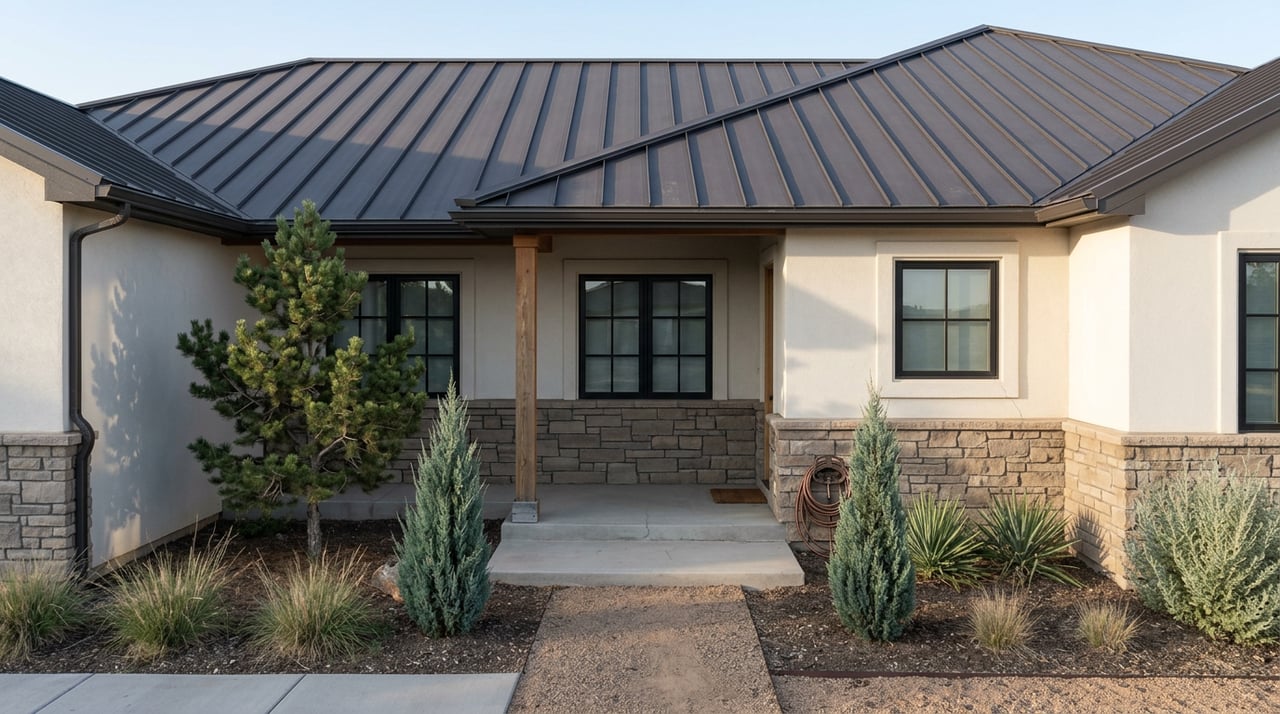
A three-bedroom ranch in Pueblo West and a nearly identical one in Pueblo city limits do not sell for the same money, and the gap is bigger than most buyers expect. Over the three months ending May 2026, the median resale price in Pueblo West sat at $400,000. Across the county line in Pueblo proper, that same window put the median somewhere between $245,000 and $308,000 depending on which data source you check. That's not a rounding difference. That's a premium of 30 to 60 percent for homes that, on paper, share a county line, a highway corridor, and roughly the same commute to downtown Pueblo.
The lifestyle story explains part of it: bigger lots, wide-open sightlines, a golf course, an equestrian trail network. But lifestyle doesn't explain why that premium has held even as Pueblo West's own inventory has swelled and days on market have stretched past two months. Something structural is propping up the price floor, and it isn't the view. It's a water tap.
The Number Everyone Skips Past
Pueblo West gets its water almost entirely from one source: the district's ownership stake in the Twin Lakes Reservoir and Canal Company, supplemented by water leased from Pueblo's own utility, the Board of Water Works. That supply is finite, and the Pueblo West Metropolitan District has known it for years. Back when the district first tightened new connections, board members were weighing consultant estimates that ranged from roughly 695 new taps the system could sustain on the conservative end to nearly 2,771 on the optimistic end, a spread wide enough that nobody could say with confidence how much room actually existed.
The district's current answer, adopted as a formal policy extension, caps new water tap sales at 200 per year from 2026 through 2029, for a total of 800 released in staggered batches. A 2026 rules update also added monitoring requirements for any new development that isn't a single-family home. In plain terms: if you want to build a new house in Pueblo West today, you need to confirm a tap is actually available before you finalize a lot purchase, because the district is not selling them on demand anymore.
What a New Tap Actually Costs
For a standard three-quarter inch connection effective January 1, 2026, a builder pays $27,232.97 for water and roughly $8,096.39 for wastewater, a total north of $35,000 before a single stud goes up. That figure covers a Water Plant Investment Fee, a Water Resource Fee, and a tap fee for parts and labor on the water side, plus a separate Plant Investment Fee and tap fee for wastewater.
A new water and sewer connection in Pueblo West runs about $35,000 in district fees alone, on top of the lot and the build itself.
That number matters for a resale buyer for one simple reason: you're not paying it. If the house you're looking at already has an active tap, that connection right transfers with the property like any other utility hookup. Whether that tap was secured under today's allocation rules or installed years before any cap existed, the seller already carries it and you inherit it, no waiting list required.
Grandfathered Taps and the Quiet Value of Already Being Connected
This is the part of the tap cap that doesn't show up in a listing description but shows up in the price. Every year the district caps new sales at 200, it is also, by definition, limiting how much brand-new competing inventory can enter the market to compete against existing homes for sale. A buyer who wants a move-in-ready house in Pueblo West this year isn't just choosing between resale listings. They're choosing between resale listings and a shrinking pool of new construction that has to clear a tap allocation before it can even break ground.
That scarcity doesn't announce itself on a for-sale sign. It shows up as a price floor that holds even when the market softens elsewhere. It's a quieter version of the same math that makes an established taxi medallion worth more than the cost of a new one when a city caps the number of medallions it issues.
The Utility Line You Can't See in Photos
Here's the complication a comparison shopper needs to know before assuming any two Pueblo West listings are apples to apples. Only about 45 percent of lots in the district sit on the central sewer system. The rest rely on individual sewage disposal systems, permitted through Pueblo County's health department rather than the metro district. A perc test, an engineer's design, and a county permit stand between a septic lot and a certificate of occupancy, and none of that history is visible in a listing photo.
Even among sewer-connected homes, the monthly math isn't identical to what a Pueblo city buyer sees. As of 2026, the typical household pays a $28.72 water readiness-to-serve fee and a $41.48 sewer readiness-to-serve fee, plus a $5 sewer debt service charge that's been in place since 2011 and stays on the books until a bio-solids facility loan is retired, roughly twenty years out from its original approval. Layer on a newer $1.50 monthly fee, approved by the board in November 2024 and effective that January, that shifted responsibility for water-main-to-meter repairs from the homeowner to the district, a change meant to head off the kind of $5,000 to $8,000 surprise repair bills that used to land entirely on property owners. Repairs from the meter to the house itself, notably, are still the owner's problem.
None of these fees are large individually. Together, they're the kind of detail that separates a buyer who understands what they're carrying from one who finds out at their first water bill.
Inventory Is the Wrinkle in the Scarcity Story
If the tap cap were the whole story, Pueblo West's market would look tight. It doesn't, at least not right now. In the 30 days ending in April 2026, months of supply in Pueblo West had climbed to roughly 12 months, up from about 3.25 months the year before, alongside a rise in total active listings and a growing share of sellers cutting price. The pricing data itself doesn't agree on direction: Redfin's one-month snapshot as of July 2026 showed average sale prices down close to 10 percent year over year, its own three-month median through May was down just under 6 percent, and a separate 30-day read from April actually showed the median up slightly. When three measurements of the same market point three different directions inside a single year, that's a market in the middle of resetting, not one moving cleanly in either direction.
That's not a contradiction so much as two different clocks running at different speeds. The tap cap controls how fast brand-new supply can enter the market over years. It does nothing to stop existing owners from listing their homes this month, and plenty of them have. The long-run scarcity story that supports Pueblo West's premium over Pueblo city is still intact. The short-run picture, for a buyer shopping this fall, currently favors more negotiating room than the headline median suggests.
There's also a piece of the water supply itself worth watching. Part of Pueblo West's allocation comes from a lease with Pueblo's Board of Water Works, an agreement the two governments signed in January 2022 for a five-year term, alongside a separate deal charging Pueblo West $1,500 for every new tap sold under that lease. A five-year term that began in January 2022 puts renewal squarely in the current window, so a buyer or investor thinking several years out should treat today's tap allocation as the current rule rather than a fixed one.
What This Means If You're Comparing Neighborhoods
If you're weighing a move to Pueblo West against staying in Pueblo proper, the price gap is real, but it isn't only paying for acreage and view corridors. Part of what you're paying for is a scarce resource, rationed by a government body, that keeps new competition limited. That's worth knowing before you assume the premium is purely a lifestyle tax you can shop your way around.
If you're comparing two Pueblo West listings against each other, the sewer-versus-septic question deserves the same weight as square footage. Confirm it directly with the district rather than guessing from the street or the subdivision name, since two houses ten minutes apart can sit on completely different systems.
A Few Questions Buyers Ask Before They Compare Pueblo West to Pueblo
Does the tap cap affect me if I'm buying a home that's already built? No, not directly. An existing home already carries an active water and sewer tap that transfers with the sale. The cap governs new connections the district issues each year, which is why it shapes new construction timelines and costs rather than resale transactions. It does, however, explain part of why resale prices hold up.
How do I find out if a specific property is on sewer or septic? Ask the district directly rather than assuming by address or subdivision. If the home relies on an individual sewage disposal system, confirm the permit history with Pueblo County's health department before you write an offer, since septic condition and age can vary widely even on similar-sized lots.
Could the 200-taps-per-year policy change before 2029? It's possible. The district has revised its tap allocation before, and consultants have disagreed sharply in the past over how many new connections the water supply can actually support long term. Treat the current schedule as this year's rule, not a permanent ceiling.
Comparing Pueblo West to Pueblo city, or trying to figure out whether a specific lot sits on a scarce tap or an aging septic field, is exactly the kind of question that looks simple until you're the one signing the contract. John Liese of Colorado Foothills Properties works these details for a living across Fremont and Pueblo counties. Work With John before you make your next offer, not after.