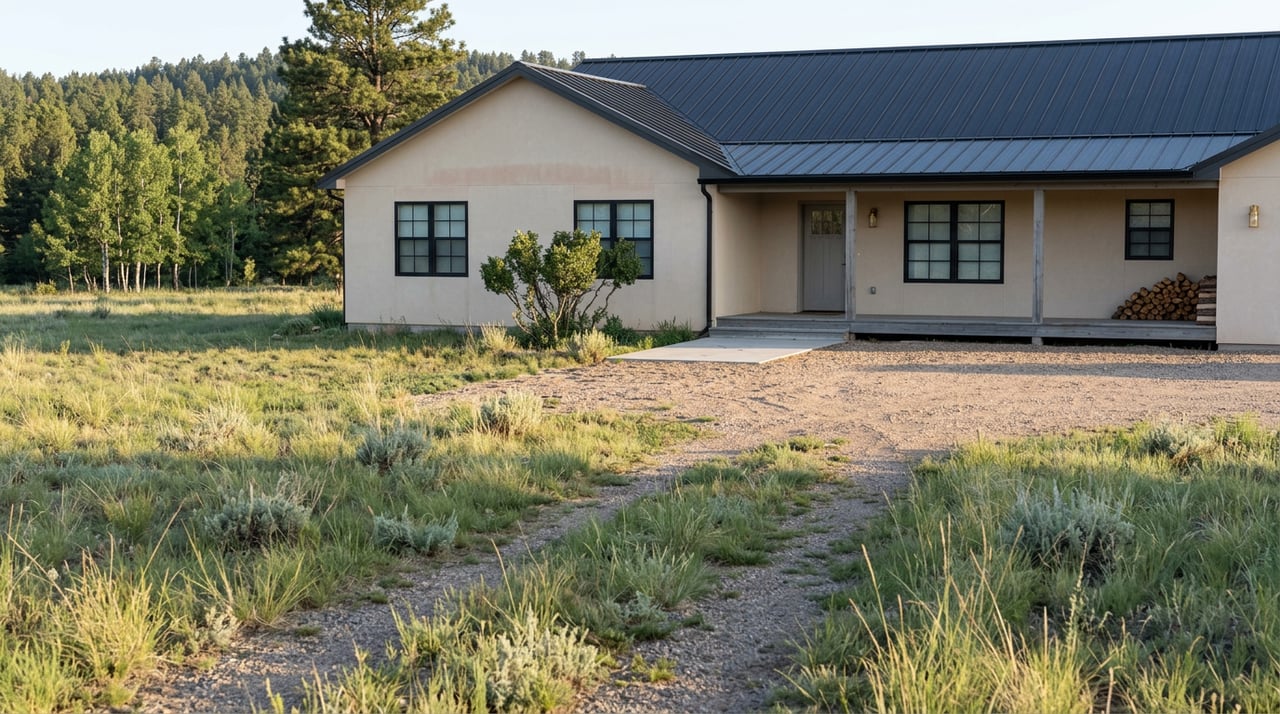
A Colorado real estate attorney once described a client who bought five acres outside a mountain town with plans to run a small training stable. The seller said the well could water all five acres. Both agents in the deal said the same thing. A contingency to that effect even went into the contract. A year after closing, the buyer found out by accident that the well was permitted for household use only. No hose. No trough. No irrigation. The case settled for $30,000, split between the brokers and the seller.
That story didn't happen in Cotopaxi specifically, but it describes exactly the trap waiting in most of the land currently for sale there. If you've been comparing per-acre prices across Cotopaxi listings, you've been reading half the number. The other half, the one that actually determines what you can do with the land, is the acreage figure sitting right next to the price. In Colorado, that number crosses a legal line at 35 acres, and most of what's listed near Cotopaxi right now sits well below it.
The Line at 35 Acres
Colorado's exempt well rules split rural land into two categories, and the split has nothing to do with soil or location. It's acreage.
A parcel of 35 acres or more generally qualifies for a domestic well permit. That permit allows water for up to three single-family homes, irrigation of up to one acre of lawn or garden, and watering of livestock and domestic animals. A parcel under 35 acres typically gets a household-use-only permit instead, unless it falls under one of two exceptions covered below. Household-use-only means water for sinks, showers, and toilets inside one dwelling. Nothing outside the house. A water engineer with Colorado's Division of Water Resources put it plainly in a 2025 interview with Colorado Public Radio: "even watering a flower pot on your front porch technically would not be allowed" under that permit type.
This isn't a Cotopaxi-specific quirk. It's statewide law, tied to the state's prior appropriation system for groundwater. But it hits differently in a market like Cotopaxi, where the land for sale skews small.
What's Actually For Sale Right Now
Scan the active Cotopaxi land listings and a pattern shows up fast. The bulk of what's on the market clusters in the 2 to 20 acre range. A 2.02-acre parcel priced at $13,997. A 2.61-acre lot at $16,900. A 5.42-acre property in Spruce Basin at $60,000. A 6.5-acre parcel in the Glen Vista community advertised with a household well already in place. A 4.79-acre tract in Florida-Colorado Acres near Cotopaxi listed at $24,000, with no utilities at all and a note that well and septic would need to be developed. Across roughly 4,000 acres of currently listed Cotopaxi land, the average price works out to about $17,322 per acre, based on active MLS data compiled earlier this year.
Almost none of that inventory clears the 35-acre threshold. The larger properties do exist, places like a 192-acre ranch along Texas Creek or a 77-acre mountain property with pasture and pine, and those parcels sit on the other side of the line, eligible for the fuller domestic permit. But if you're shopping the price range where most Cotopaxi land actually trades, you're shopping parcels where the default well status, absent one of two exceptions, is household use only.
That matters for the same reason it mattered in the training-stable case. A listing that mentions "well already installed" or "power at the lot line" is telling you the infrastructure exists. It is not telling you what the infrastructure is legally allowed to do.
Two Ways Around the Line
The 35-acre rule isn't absolute. Two things can override it.
The first is a grandfathered well. If a well on a parcel under 35 acres was drilled and permitted before May 8, 1972, it can retain domestic-level rights regardless of current acreage. That's a real exception, and it's one reason an older, established Cotopaxi property with a well can sometimes be worth more than a newer parcel with a similar acreage count.
The second is an augmentation plan. Some subdivisions went through Colorado's water court process to secure replacement water, allowing homeowners inside that subdivision to pump under an augmented permit even on smaller lots. Whether a specific parcel benefits from one depends entirely on whether it sits inside a subdivision that filed and maintains that plan, and whether the plan is still active. A plan that was approved a decade ago and has since lapsed does you no good at closing.
Neither exception is something you can confirm from a listing description. Both require pulling records.
What to Verify Before You Write an Offer
The permit type is public record. Here's what that means in practice:
- Get the well permit number from the seller or listing agent, not a verbal description of what the well "can do."
- Search that permit through Colorado's Division of Water Resources well permit search tool, which shows the permitted use, depth, and any conditions tied to the permit.
- If the well predates 1972, confirm the completion date shown in that same record. The date is what establishes the grandfather status, not the seller's word.
- If the parcel is part of a subdivision, ask whether a water supply plan or augmentation plan was filed with the county and whether it's still in force.
- For anything routed through Fremont County specifically, the county's well permit office can confirm what's on file locally before you're deep into a contract.
None of this takes long. It takes minutes if you know what number to search. It takes a lawsuit if you don't.
What This Means When You're Comparing Price Per Acre
Here's the part that changes how you should read those per-acre numbers. A $5,000-per-acre parcel with a household-use-only well and no clear path to an upgrade isn't necessarily a better deal than an $11,000-per-acre parcel with a grandfathered domestic well or a spot inside an active augmentation subdivision. The cheaper parcel may look like a bargain until you factor in what it costs to live on land you can't water. Trucked-in water and cistern storage are legal workarounds, but they carry ongoing delivery costs and can become unreliable in winter when roads are hard to service. An augmentation plan, if you have to buy into one yourself rather than inherit an existing one, can run into real money and take months to finalize through water court.
None of that shows up in the price-per-acre column. It only shows up once you've pulled the permit.
A Few Questions Worth Asking Directly
Can I combine two smaller parcels to reach 35 acres and qualify for a domestic well? Sometimes, but only if the county formally recognizes the combined tract as a single legal parcel before you apply for the permit. Two adjoining five-acre lots under separate legal descriptions don't automatically count as one 40-acre property in the state's eyes.
How do I confirm a well actually predates the 1972 cutoff? The completion date is part of the permit record on file with the Division of Water Resources. You can search by parcel address or owner name rather than relying on what a seller remembers.
If a listing doesn't mention the well permit type at all, what should I assume? Assume nothing. Request the permit number in writing and verify it yourself before the inspection period closes. That single step is what separates buyers who end up with the property they thought they bought from buyers who end up in a dispute over one.
Cotopaxi's land market rewards buyers who read past the listing photos, and the well permit question is the clearest example of why. If you're comparing acreage in Fremont County and want a straight answer on what a specific parcel's water rights actually allow before you write an offer, that's the kind of groundwork Colorado Foothills Properties does before you're standing on the land. Work With John.